

On September 9, 2013, Bill McBride writes on the Calculated Risk blog:
The first graph shows the change in private sector payroll jobs from when each president took office until the end of their term(s). President George H.W. Bush only served one term, and President Obama is in the first year of his second term.
Mr. G.W. Bush (red) took office following the bursting of the stock market bubble, and left during the bursting of the housing bubble. Mr. Obama (blue) took office during the financial crisis and great recession. There was also a significant recession in the early ’80s right after Mr. Reagan (yellow) took office.
There was a recession towards the end of President G.H.W. Bush (purple) term, and Mr Clinton (light blue) served for eight years without a recession.
The first graph is for private employment only.
The employment recovery during Mr. G.W. Bush’s (red) first term was very sluggish, and private employment was down 946,000 jobs at the end of his first term. At the end of Mr. Bush’s second term, private employment was collapsing, and there were net 665,000 private sector jobs lost during Mr. Bush’s two terms.
Private sector employment increased slightly under President G.H.W. Bush (purple), with 1,490,000 private sector jobs added.
Private sector employment increased by 20,864,000 under President Clinton (light blue) and 14,688,000 under President Reagan (yellow).
There were only 1,933,000 more private sector jobs at the end of Mr. Obama’s first term. At this early point in Mr. Obama’s second term, there are now 3,254,000 more private sector jobs than when he initially took office.
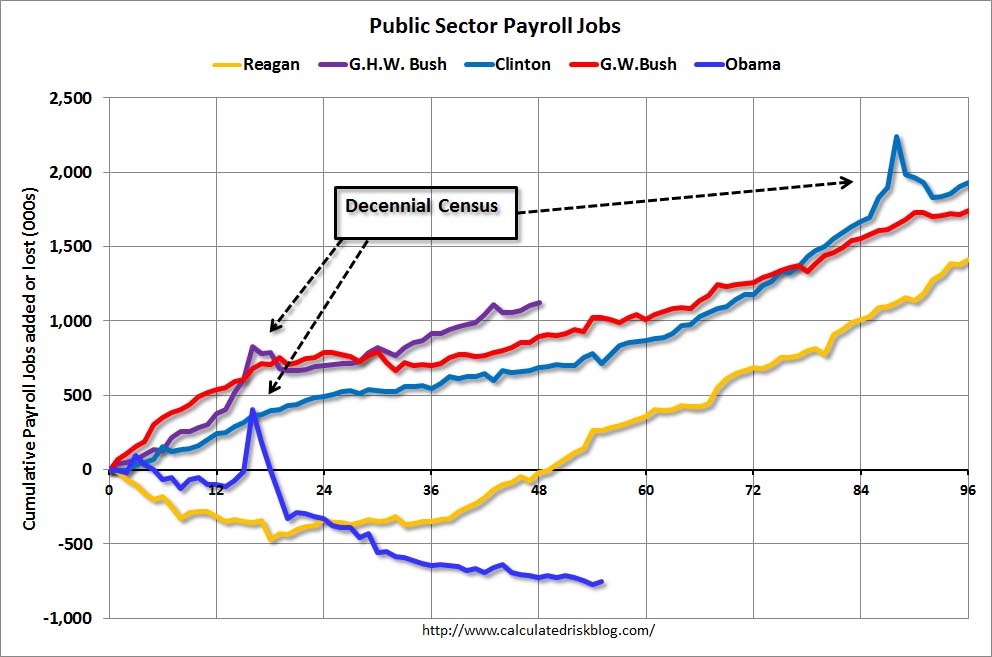
A big difference between the presidencies has been public sector employment. Note the bumps in public sector employment due to the decennial Census in 1990, 2000, and 2010.
The public sector grew during Mr. Reagan’s terms (up 1,414,000), during Mr. G.H.W. Bush’s term (up 1,127,000), during Mr. Clinton’s terms (up 1,934,000), and during Mr. G.W. Bush’s terms (up 1,748,000 jobs).
However the public sector has declined significantly since Mr. Obama took office (down 752,000 jobs). These job losses have mostly been at the state and local level, but more recently at the Federal level. This has been a significant drag on overall employment.

Without substantial economic growth in the +5 to -10 GDP range, employment will continue to stagnate. We need to implement policies which simultaneously grow the economy while creating broadened individual ownership of corporations, where wealth-creating, income-producing productive capital are assets, and embrace the shifts in the technologies of production that require far less human labor. Thereby shifting from wage- and salary-dependent income to stock dividend income.
http://www.calculatedriskblog.com/2013/09/public-and-private-sector-payroll-jobs.html
