

On September 23, 2014, David Stockman writes on Contra Corner:
Among the many evils of monetary central planning is the conceit that 12 members of the FOMC can tweak the performance of a $17 trillion economy on virtually a month to month basis—using the crude tools of interest rate pegging and word cloud emissions (i.e. “verbal guidance”). Read the FOMC meeting minutes or the actual transcripts (with a five-year release lag) and they sound like an economic weather report. Unlike the TV weatherman, however, our monetary politburo actually endeavors to change the economic climate for the period immediately ahead.
Accordingly, the Fed is pre-occupied with utterly transient and frequently revised-away monthly release data on retail sales, housing starts, auto production, business investment, employment and inflation. But its always about the latest ticks in the data—never about the larger patterns and the deeper longer-term trends. And of course that’s the essence of the Keynesian affliction. The denizens of the Eccles Building—-overwhelmingly academics and policy apparatchiks—-rarely venture into the real economic world, and, therefore, do believe that the US economy is just a giant bathtub that must the filled to the brim with “aggregate demand” and all will be well.
Filling the economic bathtub is accomplished through something called “monetary accommodation”, which essentially means credit expansion. That is, market capitalism left to its own devices is inherently suicidal—or at least a chronic underperformer. Households and businesses almost always spend too little and therefore need to be induced to become more exuberant in the shopping aisles and on the factory floor.
In this framework, the blunt instrument of artificially depressed interest rates is the natural policy tool of choice. If cautious households are saving too much for a rainy day or even their children’s education or their own retirement, why club them with ZIPR (zero interest rates); get them shopping until they drop. Likewise, if businessmen do not see the case for opening another store or buying a new lift truck for their warehouse (or expanding same), bribe them with cheap debt financing.
In short, the primary route of monetary policy transmission for Keynesian central bankers is the credit expansion channel. Using that economic plumbing system they endeavor to goose aggregate demand and thereby fill the economic bathtub to its brim—otherwise know as potential output and full employment. Furthermore, by a Keynesian axiom—-known as the Phillips Curve trade-off between inflation and employment—there is no possibility of serious goods and services inflation until the tub is fall and all capital and labor resources are fully employed.
So the whole gig amounts to a simple mandate: Keep pumping aggregate demand through the credit channel until potential GDP is fully realized because, ipso facto, that means that the Fed Humphrey-Hawkins mandate of price stability and maximum employment have also been achieved. So in effect, the Fed heads watch the ticks and blips of the “in-coming data” with such intensity because they believe their job will be done when the US economy finally reaches its brim.
This entire Keynesian bathtub model is nonsense, of course, not the least because the US economy is not a closed system, but functions in a rambunctious, open global economy where massive flows of trade, investment and finance impinge heavily on prices, costs, wages and productive asset returns, and therefore the daily behavior of millions of domestic workers, businesses, investors and financial intermediaries. So the Fed’s Keynesian model is fundamentally flawed—-a reality that perhaps explains its stubborn adherence to policies that do not achieve their stated macro-economic objectives, but fuel serial financial bubbles instead.
However, even apart from the fundamental flows of its basic economic model, the Keynesian pre-occupation with the economy’s mythical full-employment brim and the short-run business cyclical fluctuations related to it cause our monetary central planners to ignore the obvious. Namely, that the credit transmission channel is broken and done, and that the massive resort to money printing—especially since the dotcom bust in 2000—have been accompanied by sharply deteriorating economic trends.
Stated differently, the growth rate and general health of the US economy has drastically down-shifted during the last decade and one-half and now stands at only a fraction of its historic trends. Specifically, real GDP grew at a 4.0% rate during the golden age of sound money and fiscal rectitude between 1950 and 1970. Then it dropped to about 3% during the next 30 years after Nixon defaulted on our Bretton Woods obligation to redeem the dollar in a constant weight of gold; and since the dotcom bust in 2000 when the Greenspan Fed went all out with printing press monetary expansion, real GDP growth has amounted to only 1.7% annually. That is just 42% of its golden age rate, and in truth probably even worse if inflation were to be honestly measured by the government statistical mills.
Faltering growth, in turn, has meant job market deterioration and declining investment in productive assets. Indeed, during the last 175 months of intense economic weather watching the Fed has never once noticed that since the turn of the century breadwinner jobs have declined by 5%, real net investment in business plant and equipment is down by 20% and the median household income is not only sharply lower, but actually only at levels first achieved in 1989.
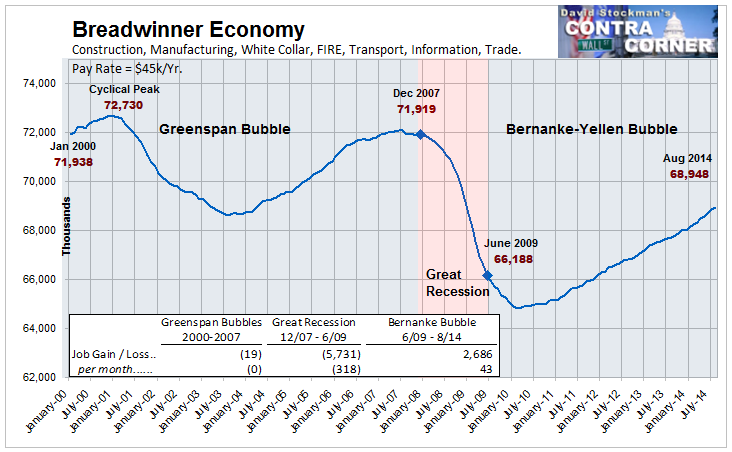

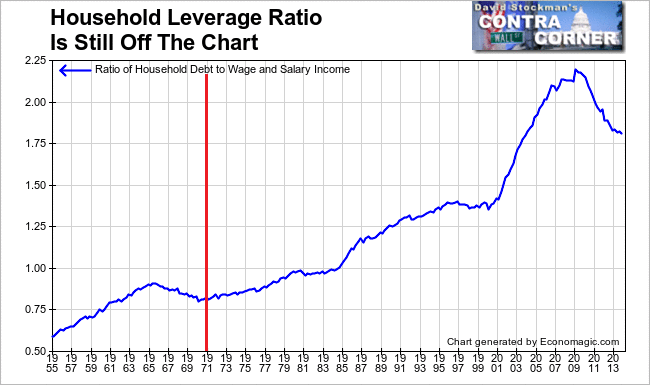
Needless to say, these failing trends in the fundamental measures of macroeconomic health occurred at a time when the Fed balance sheet virtually exploded, rising from $500 billion to nearly $4.5 trillion—or by 9X—during the same 14 year period. Yet it keep attempting to shove credit into the economy notwithstanding this self-evident failure because at the end of the day there is nothing else in its playbook. We have reached peak debt in both the household and business sector, meaning that the fed’s massive flood of liquidity never get out of the canyons of Wall Street.
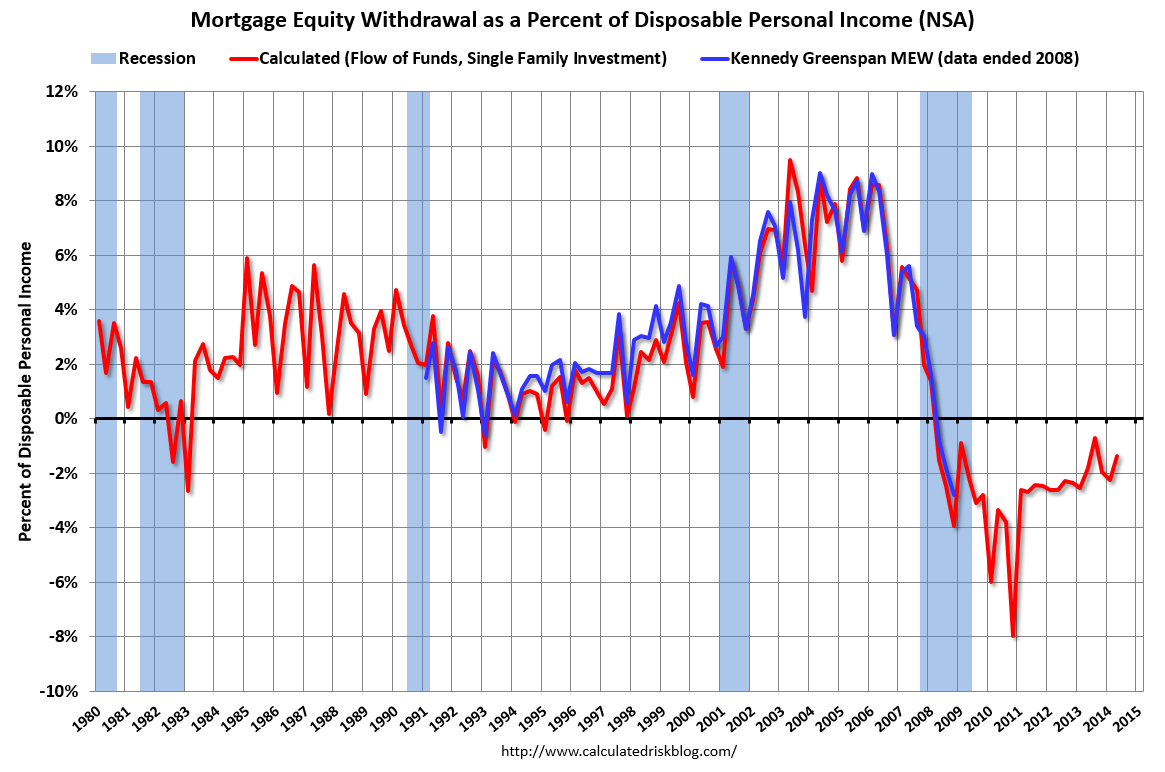
In short, believing they are filling the macroeconomic bathtub, Janet Yellen and her merry band of Keynesian money printers are simply blowing chronic, giant, dangerous bubbles on Wall Street. If they are beginning to become fearful of a Wall Street hissy fit, perhaps they should look at the two charts below.
Easy money is always the wrong medicine, but most especially for an economy that is already and self-evidently saturated with too much debt.
The Federal Reserve System needs to be reformed to act as a purveyor of economic growth.
Influential economists and business leaders, as well as political leaders, should read Harold Moulton’s The Formation Of Capital, in which he argues that it makes no sense to finance new productive capital out of past savings. Instead, economic growth should be financed out of future earnings (savings), and provide that every citizen become an owner. The Federal Reserve, which has been largely responsible for the powerlessness of most American citizens, should set an example for all the central banks in the world. Chairman Benjamin Bernanke and other members of the Federal Reserve need to wake-up and implement Section 13 paragraph 2, which directs the Federal Reserve to create credit for local banks to make loans where there isn’t enough savings in the system to finance economic growth. We should not destroy the Federal Reserve or make it a political extension of the Treasury Department, but instead reform it so that the American citizens in each of the 12 Federal Reserve Regions become the owners. The result will be that money power will flow from the bottom up, not from the top down––not for consumer credit, not for credit that doesn’t pay for itself or non-productive uses of credit, but for credit for productive uses to expand the economy’s rate of growth.

Thank you for evaluating a recent perspective.
Inequality, Nick Hanauer and the Patriot’s Moral Code.
Here is a new one on Huff Post, about the Fed’s less than genuine compassion for the working class.
http://www.huffingtonpost.com/timothy-j-barnett/the-federal-reserves-artf_b_5884384.html